The Side the Engraving Did Not Show
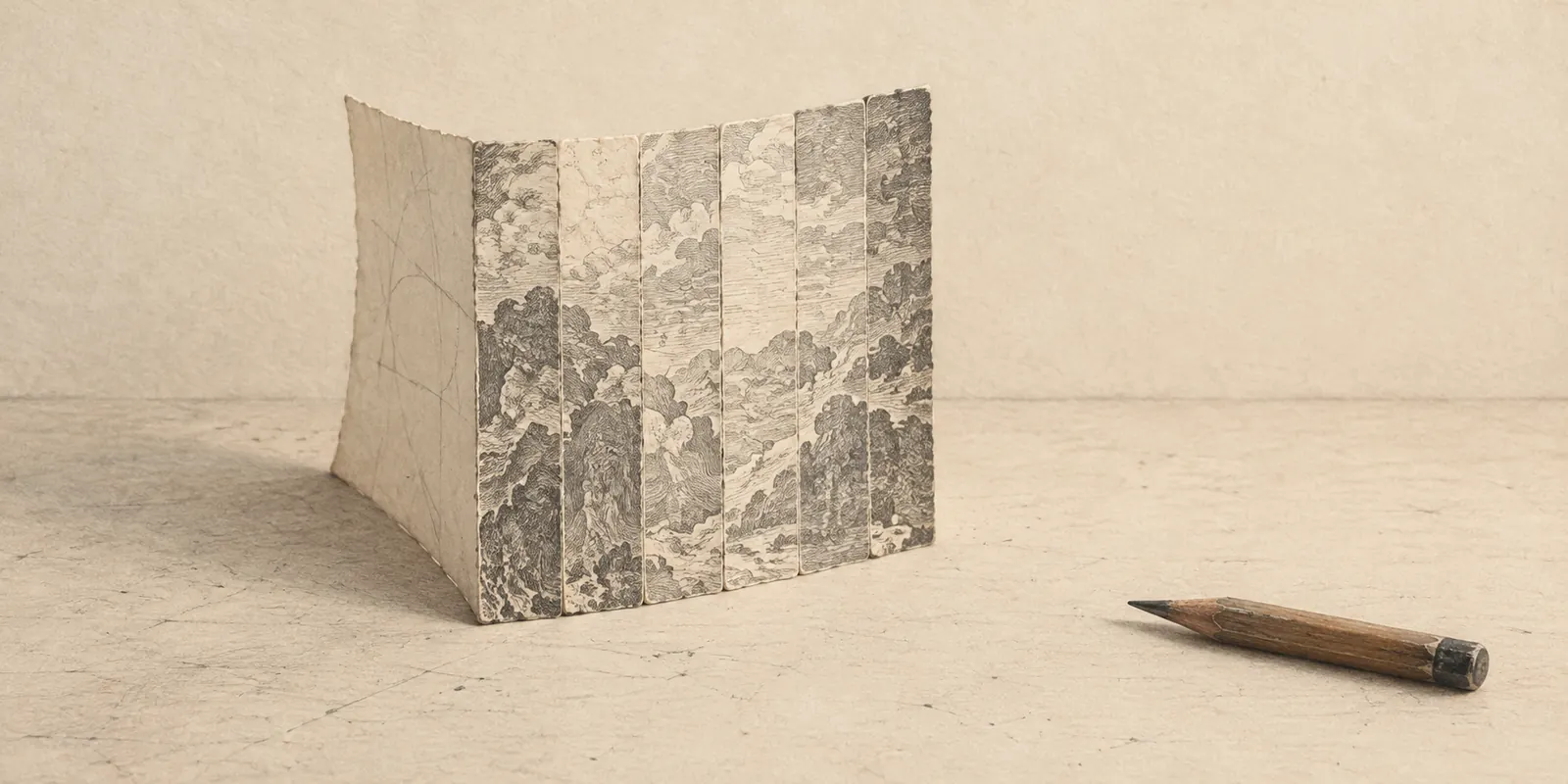
A Piranesi etching becomes a three-dimensional Trajan’s Column. The new model has a back, although the print supplied only a front.
A print of Trajan’s Column in the Hood Museum of Art is more than three metres high. It dates from about 1774. Another impression in the Museum of Fine Arts, Houston, is catalogued as an etching with engraving on six joined sheets: designed in 1774–1779 and printed around 1836. The single frontal image is itself a constructed object.
Giovanni Battista Piranesi depicted the monument with extraordinary care, but he still had to choose a side from which to show it. The engraving has a front. It does not give the viewer a continuous view around the stone.
In a 2026 paper, four researchers at the University of Perugia used that limitation as part of an experiment. Fabio Bianconi, Marco Filippucci, Lucio Fiorini and Chiara Mommi took historical engravings by Piranesi and asked generative systems to turn them into three-dimensional objects. Their most revealing result may be the portion of the column that Piranesi did not draw.
Figure 4 of their paper places the engraved upper section beside two views of a generated model. One faces forward; the other shows the back. The rear looks like a continuation of the reliefs on the front. It is an output of the modelling process, not evidence recovered from the reverse of the monument.
A second view from a single one
The researchers did not begin with a laser scan or a complete set of photographs. For each case they supplied one historical image to a generative image model, NanoBanana within Gemini, and asked it to transform the perspective into a 45-degree axonometric view. The instructions included a square base with perpendicular sides. This intermediate picture was then sent to Meshy to generate a polygonal 3D model, using the platform’s default presets.
The axonometric view was already an interpretation. A slanting, dramatic perspective had been regularised; shapes not visible in the print had to be filled in. Meshy then worked from that synthetic view, estimating volumes and surfaces that could continue around an object. A rotatable model must have geometry where the original drawing offers none.
The difference is especially clear on the column. The researchers report that the main masses of its base survive the conversion fairly well. Small inscriptions and sculptural details do not: they gradually become less legible, absorbed into surface texture. The software preserves the impression of carved stone more easily than the specific information in the carving.
At the top, the problem changes. The engraving includes a human figure. In the intermediate axonometric drawing it remains recognisable; in the 3D step, anatomy, posture and attributes become unstable. Figure 7 shows different generated versions of the figure from the same input. They are not competing discoveries about the statue. They are variations produced where the source leaves the model too much room.
The team also tried views of Castel Sant’Angelo and St Peter’s Square. Their broad masses and spatial arrangement remained recognisable, while fine architecture and ornament were simplified. For Castel Sant’Angelo, the authors say that rotating the model exposes discontinuities that are less obvious from the original viewing direction. The apparent completeness depends on where one stands.
What can be checked
These cases are not all uncertain in the same way. Trajan’s Column and Castel Sant’Angelo exist; a generated back can in principle be compared with measurements and photographs from other viewpoints. Piranesi’s Carceri d’Invenzione offer no equivalent physical object. When the researchers turn one of those impossible interiors into 3D, there is no historical building whose hidden side could settle the question.
The authors use Piranesi because his engravings were already a mixture of observation and invention. His shifts of scale and perspective were artistic decisions. A generative model’s missing detail or improvised geometry is not the same kind of decision, even when the results invite a visual comparison. The parallel is useful only if the difference remains visible.
The paper asks for paradata: records of the choices, transformations and inferences that led from a source to a reconstruction. The term matters here. A final model can look continuous while the evidence behind it is discontinuous. Keeping the intermediate image, prompt and source alongside the output makes it possible to ask which part was observed and which part was supplied.
I read the full research paper and inspected its figures 4, 7 and 8, as well as museum catalogue records for the engraving. I did not handle the print, inspect a model interactively or run the Gemini–Meshy pipeline. The study presents illustrated cases and methodological arguments, not a measured accuracy benchmark proving that these reconstructions are faithful.
Piranesi’s sheet gives us one deliberate view of a monument. The generated object offers many more views, but their availability is not the same as additional evidence. Sometimes the most informative part of a model is precisely the side that nobody ever recorded.
A Note on Sources
Directly checked: Bianconi, Filippucci, Fiorini & Mommi, 'Ricostruzioni tridimensionali e capricci di invenzione IA di Giovanni Battista Piranesi', Archeologia e Calcolatori 37.1 (2026), pp. 313–332, especially methods pp. 315–317, Trajan’s Column pp. 318–322, Castel Sant’Angelo p. 323 and discussion pp. 325–328; the journal’s figure pages 4, 7 and 8; the Hood Museum and MFAH catalogue records for Piranesi’s etching. The Hood record dates its sheet to about 1774; the MFAH record distinguishes the work’s 1774–1779 date from the circa-1836 printing of its own six-sheet impression. The paper documents outputs but provides no independent metric validation here. I did not rerun either generative service, handle the original engraving, examine interactive meshes or check them against a survey of the monuments. 'The missing side' is an editorial focus on the paper’s documented inferential completion, not a newly discovered archaeological feature.
A generated reverse of Trajan’s Column
The 2026 paper’s figure 4 shows a plausible reverse reconstructed from Piranesi’s frontal etching; figure 7 shows variants of a figure from the same input.