The Painting Entered to Be Forgotten
A Chicago art contest asked artists to make pictures people would remember or forget. One entry submitted to be forgettable finished tied for twelfth among the most memorable.
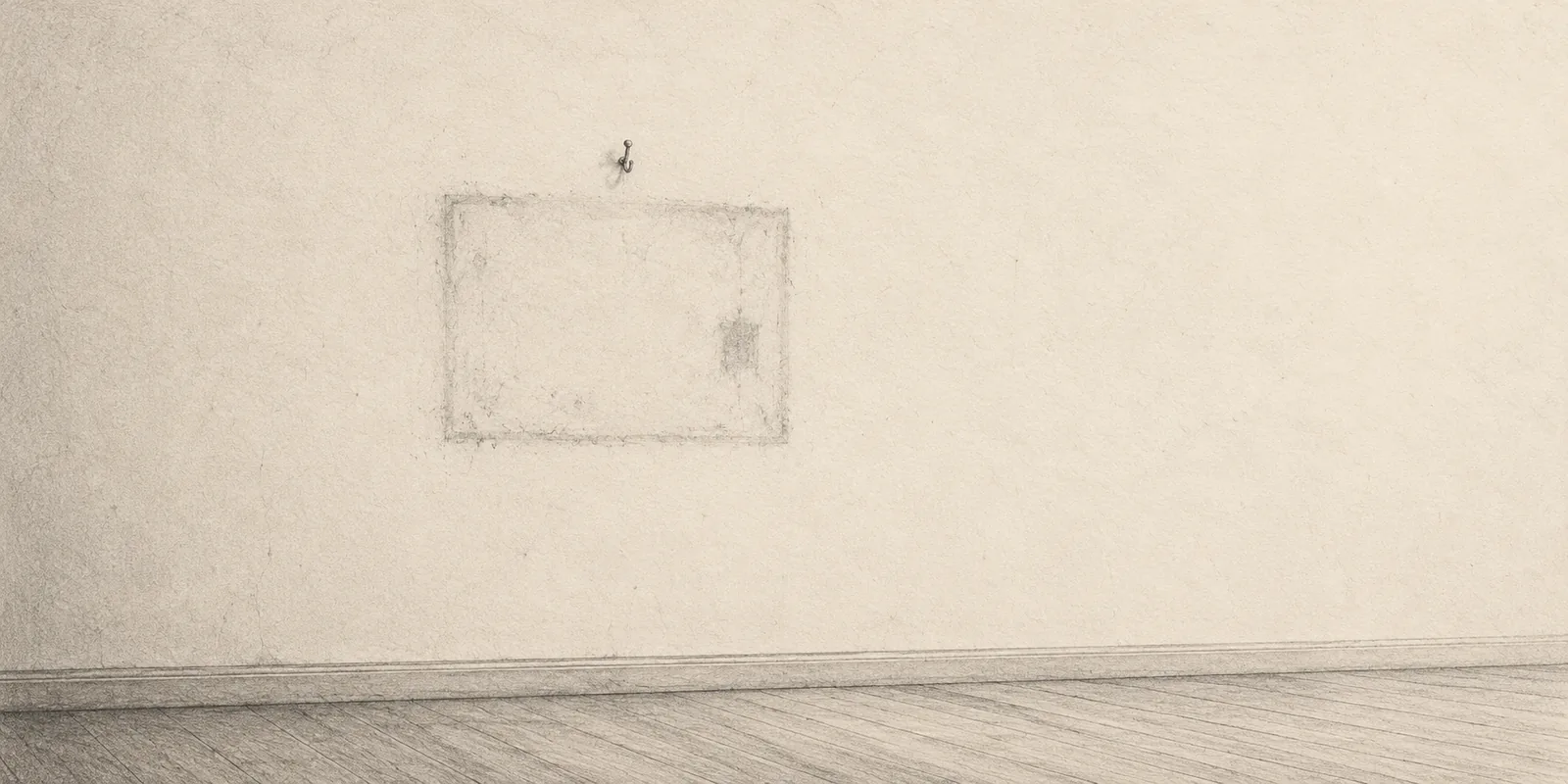
In the Brain Bridge Lab's online gallery, The House is Empty appears in the list of twenty most memorable artworks. Agnieszka Jarzabek's painting shares twelfth place, with a score rounded to 0.953. That is not the category its maker chose. In the research supplement, the entry at that position was submitted to the forgettable contest.
The distinction is recoverable by putting two documents beside each other. The gallery gives the artists and titles. Supplemental Table S1 gives the scores, ranks and artists' stated intentions, but not the titles. Two works share twelfth place. The second artist describes making a painting from an old family wedding photograph; the second title is Just Married. The other, The House is Empty, is the entry whose maker tried to make an intentionally unremarkable image.
That artist explained her aim in terms of subject, composition and colour. She wanted to see whether she could make a work that left little impression. The online recognition experiment placed it among the highest-scoring works later selected for the exhibition. It did not measure whether the painting was good, beautiful or personally meaningful to its viewers.
The rules of forgetting
The contest began in 2024 at the University of Chicago. Entrants had to choose one side, memorable or forgettable, and submit an original work that could hang on a wall. Photographs and digital art were excluded. They were also asked for progress pictures, so the researchers could see the work taking shape. The first prize was $1,000 in each category. Unlike a conventional art prize, the ranking would come from a recognition experiment rather than a jury's aesthetic preference.
The lab's rules define memorability on a scale from zero to one. The research supplement gives the more precise number for Jarzabek's work, 0.953488, and calls the measure corrected recognition, or CR. In the team's earlier published method, this is the rate of correct recognition minus false alarms. It is not a claim that 95.3 per cent of gallery visitors remembered that painting, or that any particular person will remember it.
The reverse also happened. Untitled, by Noah Karapanagiotidis, was entered as memorable but came fifth in the list of most forgettable works, with a corrected score of 0.558824. The artist's explanation mentions a cat, contrasting forms and the mixture of realistic and abstract figures: choices intended to make the image stand out. Here the gallery and Supplemental Table S2 can again be matched by rank and score. The work's visual effect has not been independently analysed for this article.
Two walls, then four boards
The forty selected works went on show at Connect Gallery in Chicago. In a 2024 interview, the curator and researcher Trent Davis described how the memorable paintings were hung together on one wall and the forgettable paintings on the opposite wall. Visitors could take a recognition test after leaving. Such an arrangement raises an obvious question: were people remembering the artworks, or where they had seen them?
The 2026 paper's supplementary material reports a separate check from the 2024 Vision Sciences Society meeting. Researchers printed 39 of the winning artworks at the same A4 size and mixed them across four boards, rather than keeping the two categories apart. Among 141 volunteer attendees, the mean hit rate was 0.866 for the memorable group and 0.614 for the forgettable group; the reported difference was statistically significant. Those figures are hit rates in a different task, not the corrected scores used for the contest ranking. The conference sample was voluntary, and the authors did not establish that wall placement explained nothing in every setting.
The full study, published online in Psychological Science on 13 October 2026 by Davis, Yifei E. Chen and Wilma A. Bainbridge, reports three experiments. Its abstract says artists' intentions did influence memory overall, but increasing memorability was easier than making images less memorable. A neural network called ResMem predicted which works would be recognised better than the artists or other human observers did. The two crossed entries in the gallery are examples of individual failure, not a rebuttal of that group result.
Some of this story was public before the 2026 article. The lab published the contest rules and winners; a 2024 university interview described the gallery and Davis's own failed attempt to make a memorable painting. What the new supplementary tables make possible is a closer comparison between the artists' stated intentions and the lists in which their work finally appeared.
The gallery's headings describe what happened in a particular memory task. They do not necessarily describe what an artist tried to do. The House is Empty is listed under the outcome its maker had set out to avoid.
A Note on Sources
Read directly: the Brain Bridge Lab's original contest rules and winner gallery; the journal article's publicly accessible abstract (13 October 2026); its 18-page supplemental PDF, especially Tables S1–S2 and Supplemental Study S1; the University of Chicago's 2024 interview; and the team's 2023 open-access method paper. The 2026 full journal article was paywalled and was NOT read. The link between the untitled rank rows and named paintings is reconstructed from identical ranks/scores and, for the twelfth-place tie, the second artist's explicit wedding-photo description matching Just Married; the supplement does not itself print the artwork titles. Corrected recognition is not a simple percentage of viewers. The public gallery lists 20+20 works while the supplemental conference replication uses 20+19; the exact exclusion was not established here. No artworks were experimentally tested, no raw data reanalysed, and ResMem was not run. The image described by each artist is an account of intent, not a visual assessment made for this piece.
The House is Empty in two different lists
Cross-reading the Brain Bridge Lab's public winners and the artists' intentions in Supplemental Tables S1–S2 of Davis, Chen and Bainbridge (2026), with a separate 141-participant conference test.