The Lullaby I Thought Was Mine Alone
For decades, I believed I was the only child in the world who did something. Then I mentioned it to an AI.
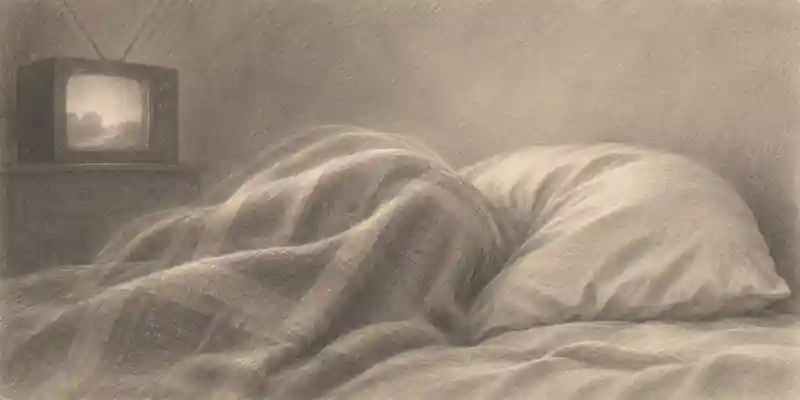
As a child, I had a bedtime ritual that only my closest family members knew about.
I would curl up on the bed, rest my head against the pillow, and begin rocking rhythmically from side to side. At the same time, I hummed the same melodies, over and over.
They were fragments of songs I’d heard on television, rearranged into repetitive little tunes. I think one came from Montagne verdi, by Marcella Bella. Another might have been Hopelessly Devoted to You, from Grease. I can no longer be certain.
I don’t remember feeling anxious or compelled to do it. It was simply how I went to sleep.
The movement and the melodies gradually carried me into that strange territory between wakefulness and sleep. By the time I stopped and settled onto the pillow, I was already so close to sleeping that I barely noticed the transition.
I did this for years. Perhaps until I was eleven, perhaps thirteen. I don’t remember when I stopped.
For most of my life, I considered it a private eccentricity. I had never met anyone who did anything similar. But then again, how often do people talk about the way they fell asleep as children?
A few days ago, almost out of curiosity, I described it to an artificial intelligence.
It suggested a term I had never encountered: sleep-related rhythmic movements.
We checked that suggestion against two sources on sleep medicine. Some children rock their bodies or move their heads rhythmically as they fall asleep. Some accompany these movements with humming or other repetitive sounds. It’s a recognized behavior, often harmless, that generally fades with age.
That doesn’t mean I can reconstruct exactly what was happening in my childhood mind. Nor does the memory require a diagnosis.
But for the first time, I realized I probably hadn’t been alone.
AI hadn’t recovered a lost memory. It had given me the words to recognize something I remembered perfectly well but had never known how to place.
Those melodies, that pillow, that peculiar way of rocking myself to sleep still belong to my childhood.
Only now I know that somewhere else, other children were rocking themselves to sleep, too.
A Note on Sources
The ritual, its melodies and the uncertain age at which it stopped come from personal memory, not a clinical record. I asked an AI for a possible name, then checked the suggestion against the American Academy of Sleep Medicine’s public explanation and a 2023 scientific review. Both describe rocking and other rhythmic movements around sleep; the AASM also mentions humming and other sounds. Rhythmic movements alone do not constitute a disorder: clinical criteria require significant consequences. No retrospective diagnosis can be drawn from this account.
Sleep-related rhythmic movements
An American Academy of Sleep Medicine explanation and a 2023 review supplied a name for a childhood behavior I had long thought was mine alone.
American Academy of Sleep Medicine
Scientific review
How this was written: the memory is mine; I wrote it up with the help of AI tools, which also helped check the sleep-medicine sources listed here. Corrections: hello@liminalfinds.com.