The Empty Paper Tube
After eighty-seven hours with the world turned upside down, George M. Stratton swapped his lenses for an empty paper tube—and saw the flat floor tilt five degrees.
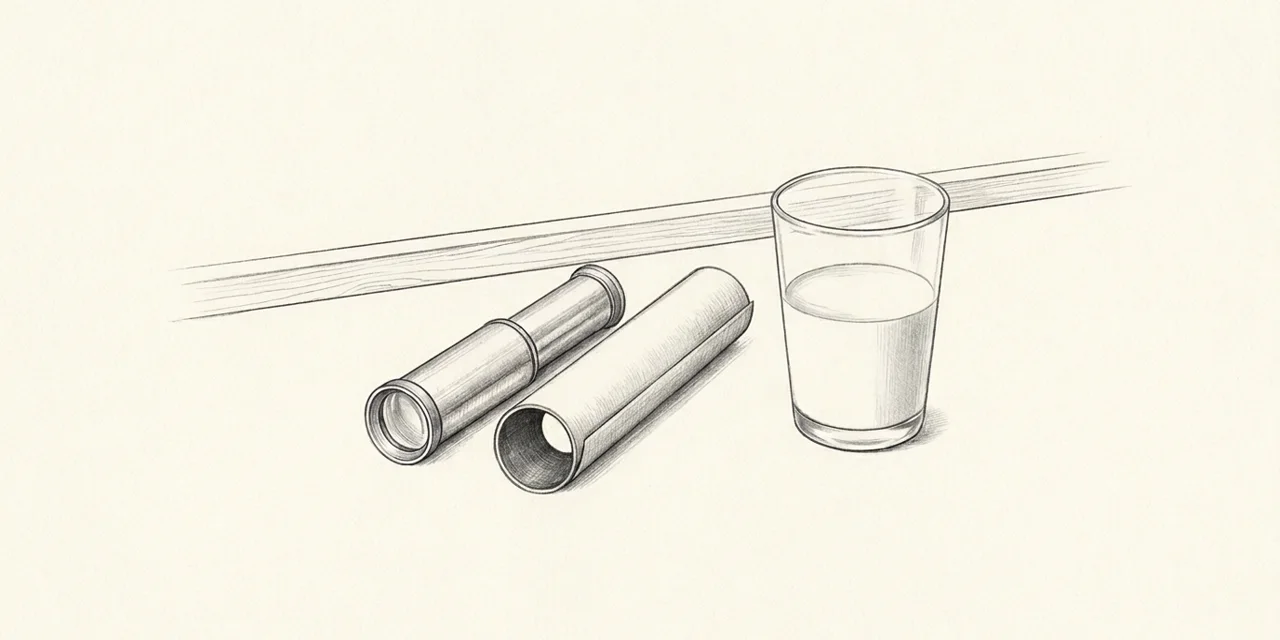
At noon on the eighth day, George M. Stratton kept the plaster cast strapped to his face, shut his eyes, and had an assistant slide the brass lens tube out of its socket. In its place the assistant slipped an empty black-lined paper tube of the same width. Stratton wanted to preserve the narrow forty-five-degree frame he had lived inside for a week, so that whatever happened when he opened his eyes would belong to flipping the world back rather than widening the view.
For eighty-seven waking hours since the first noon, only light passing through four convex lenses into his right eye had reached him. Everything—tables, his own arms, trees along a moonlit village road—had fallen on his retina upright instead of inverted, which meant he saw the room upside down and reversed left for right. When he opened his eye through the empty paper tube on page 470 of The Psychological Review for September 1897, things scarcely felt upside down. Yet the room wore what he called a "strange familiarity": turning his head sent the walls sweeping across the frame, he steered straight into chairs while trying to walk around them, stepped up nearly a foot too far from the stairs, and reached for the wrong door of two side-by-side rooms until the metalwork on the locks stopped him.
Objects ten or twelve feet off stood too high. The level floor appeared to slope upward away from him at roughly five degrees, and even after the plaster cast came off and his full sight returned, the upward tilt of the floor and windows remained noticeable in the dim light of the following morning.
The cast, the milk pitcher, and a torso
Stratton was teaching at the University of California when he published the two-part record in July and September 1897 under the title "Vision Without Inversion of the Retinal Image." He had already run a shorter three-day trial of about twenty-one and a half hours indoors in a padded pasteboard holder, reported in November 1896 after reading it at the Munich psychology congress, where remarks by Edward Titchener and questions from Hugo Münsterberg pushed him to watch dizziness, right-left shifts, and sound localization more closely. For the eight-day run he molded a thin cloth-lined plaster cast around his eyes—placing small non-adhesive pads over the lids while the plaster set so the lining would never touch them—and spent every evening after the first walking through the village under bright moonlight with a companion.
The first pages of his diary read less like optics than like learning to inhabit an unfamiliar room. On Day 1 he poured milk by carefully steering the liquid's rising surface toward the pitcher's spout and checking that the milk's surface in the glass stayed equally distant from the rim on every side. To write his notes he had to trust the automatic habits of his hand and use sight only to keep the lines spaced across the sheet. By Day 2, unseen objects could split in two: he could vividly picture the unseen fireplace in the new visual order, while the crackling of the fire pulled his ear—and a dimmer image—toward another direction.
By Day 3, looking down at his own arms and legs began to hollow out the mental map he had carried from before the experiment. His older representation of his body faded in precisely the limbs that now entered the lens tube, shrinking into "a sort of torso" whose arms and legs refused to fill in, except vaguely, even by effort of will. On Day 4 he noticed that while he still reached with the wrong hand for a book on the floor, tapping one foot near the book first brought the proper hand into play automatically.
On Day 6 two senses crossed in plain sight. Holding a writing pad with both hands, he felt a loose sheet projecting against one hand and referred the touch to the other hand visible in the frame; once he caught sight of which hand held the paper, the sensation jumped across—"changed hands," he wrote—and could not be willed back. Walking across the room, he saw the floor above him where his feet struck and heard his own footsteps coming from that upper direction, a hundred and eighty degrees away from where his ears had always placed them.
Who actually turned upside down
Even before the eight-day trial appeared in print, the experiment drew sharp fire in the same volume of the journal. In January and March 1897, the Columbia philosopher James H. Hyslop dismissed Stratton's framing as "simple nonsense." Because nobody ever perceives the retinal image itself, Hyslop argued, keeping objects reversed relative to touch proved nothing about "upright vision"; Stratton had merely studied how muscular habits and memory images re-tie themselves to a rotated picture.
Stratton's reply in March—expanded in the July and September pages—pointed out that the eye has no built-in plumb line. "Up" and "down" inside sight mean nothing until visual directions agree with touch, bodily movement, and sound. During the eight days he had felt his own eyes roll toward the sky when they actually rotated toward his feet, because felt eye motion followed the drift of things across the frame rather than raw muscle signals. When he walked briskly and kept his hands or feet in view, the scene felt right side up; only when he sat still and recalled his pre-experimental body did he feel as though he were looking out at an upright room from an inverted body.
The five-degree slope of the floor after the lenses came out still puzzled him—until several days after the close of the experiment, when he checked the plaster cast again. On page 480 he records what he found: the axis of the brass cylinder had never aligned quite squarely with his line of sight. Looking straight ahead through the lenses had lowered objects slightly in the center of the frame, an offset hidden all week by the larger upside-down turn. Because he noticed the misalignment days later, he could no longer measure it beside the aftereffect; he conceded it was barely possible the tilt came from reinversion itself, yet judged it far more likely that his eye had simply grown used to a world sitting slightly too low, making ordinary level ground look just as much too high once an empty tube replaced the glass.
A Note on Sources
Read in the complete scanned PDF and DjVu text of George M. Stratton, "Vision Without Inversion of the Retinal Image," The Psychological Review, Vol. IV, No. 4 (July 1897), pp. 341–360, and No. 5 (September 1897), pp. 463–481, on the Internet Archive (psychologicalrev04ameruoft), checking the apparatus description, the empty paper tube episode, and the post-experiment tube alignment check directly on rendered page images.
What is added. Stratton's inverting-lens experiments are widely cited in textbooks on perceptual adaptation. Here we follow three moments directly on the 1897 pages: the narrowing of his older body image to "a sort of torso" on page 351, the swap from the brass lens tube to an empty black-lined paper tube on page 470, and the admission on page 480 that a slight downward tilt of the brass tube itself likely produced the five-degree upward slope of the floor afterward.
Facts and reading. All durations (87 net hours over eight days in 1897; roughly 21.5 hours in the November 1896 preliminary run in Vol. III, pp. 611–617), sensory episodes (pouring milk, tapping a foot, the loose sheet of writing paper, footsteps shifted 180 degrees, eye-movement direction), and the exchange with James H. Hyslop (Vol. IV, pp. 71–73, 142–163, and 182–187) come directly from the primary journal issues.
What remains unknown. Stratton did not notice the downward tilt of the brass lens cylinder until several days after removing the cast, so the exact angular match between the tube's misalignment and the five-degree floor illusion rests on his retrospective check rather than simultaneous measurement. Original handwritten laboratory notebooks or surviving hardware were not consulted.
George M. Stratton, "Vision Without Inversion of the Retinal Image" (1897)
An 87-hour self-experiment from 1897 in which swapping an inverting brass lens tube for an empty paper tube left the floor appearing to slope upward five degrees—until a later check of the cast found the brass tube itself had sat slightly low.
The 1897 study (Internet Archive)
Preliminary trial and Hyslop exchange (1896–1897)
How this was written: researched and drafted with the help of AI tools, starting from the sources listed here. Editorial responsibility for what is published is mine. Corrections: hello@liminalfinds.com.