Stella's Memories
In her last years a widow came to see her husband differently. Six years after her death, Seth said she had not misremembered: she remembered another past.
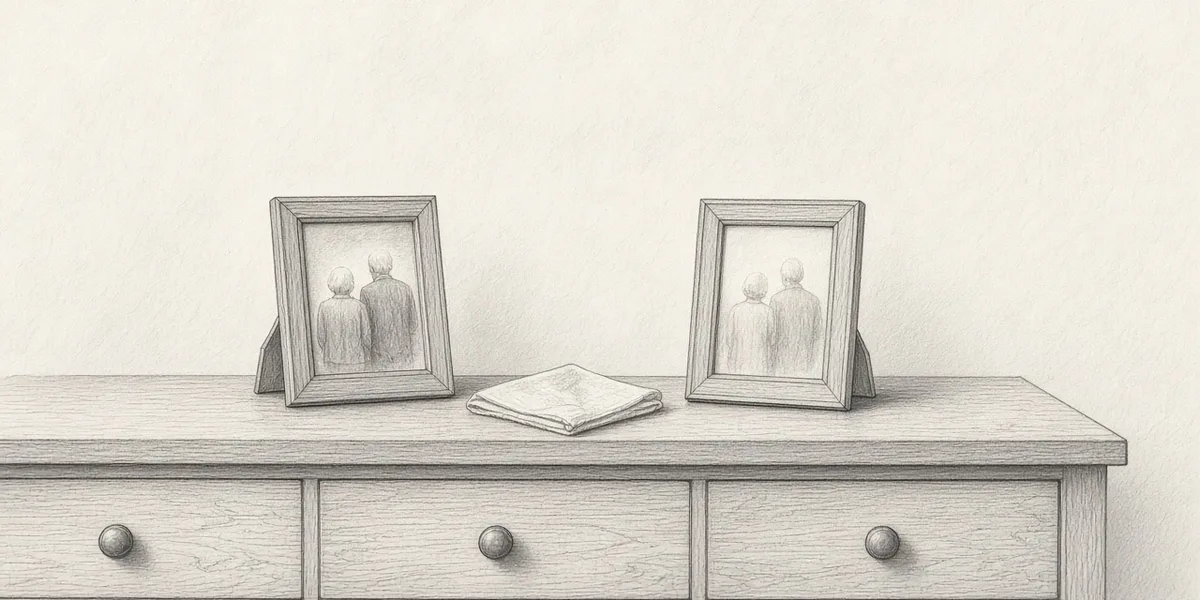
Stella Butts was widowed in February 1971 and lived a little under three more years. In that time the way she spoke about her husband changed, and changed for the better. Her son, Robert Butts, mentions it in a short note: his mother had "recreated for the better her 'memories' of her husband," and the whole family had noticed "the pronounced changes in Stella's thinking about her husband." The note says nothing more. We do not know which episodes Stella now told differently, or whether she was remembering facts in another way or reaching a new judgment about a man and a marriage. Robert puts "memories" in quotation marks and leaves it there.
Many families know a story like this: someone old, left alone, who comes to see their own life in a different light. But Robert Butts was also Jane Roberts's husband, and for twenty years he transcribed the sessions in which Jane spoke as Seth. On 26 December 1979, six years after his mother's death, in Session 891 (later published in the first volume of Dreams, "Evolution", and Value Fulfillment), Seth turned to him: "Your mother did not simply choose to believe, in her old age, in a different past than the one that was accepted by the family—she effectively changed probabilities. She was not deluded or obsessed. Her memory in that regard, now, was not defective: It was the memory of the probable woman that she became." Robert's note ends with a qualification. Everyone in the family had seen the same change, "although Jane and I were the only ones who ascribed those changes to her moving into another probable reality."
There was, then, a change the whole family had witnessed, and an interpretation that came years later, shared by only two of them. It is more exact than it first appears. Seth does not claim that Stella rewrote the family's past, which stays as "accepted by the family." Nor does he say she was wrong. He says her memory was accurate, but that it belonged to another version of her.
The idea that the present can act on the past runs through years of sessions, and not always in the same form. In Session 224, on 17 January 1966, the past is described as "a series of electromagnetic connections, held in the physical brain" that "can be changed." The past, Seth adds, "was seldom what you remember it to be, for you have already rearranged it from the instant of any given occurrence." Taken that far, it could pass for a theory of reconstructive memory. But Seth insists: "This is an actual recreation, and not a symbolic one."
Four years later the argument went elsewhere. Seth Speaks introduces the claim that "there is not just one past" (Session 530, 20 May 1970), and Session 566, on 15 February 1971, states: "The past existed in multitudinous ways. You only experienced one probable past." An exercise follows: picture a painful event replaced by another, "with great vividness and emotional validity, and many times." And then: "It is not a self-deception. The event that you choose will automatically be a probable event, which did in fact happen, though it is not the event you chose to perceive in your given probable past."
Here the alternative event is not produced by imagination. According to Seth it had already happened, along another line of probability; imagining it is a way of reaching it. Seth also reaches past the mind. In Session 654 of The Nature of Personal Reality (9 April 1973), an illness that heals is said to be erased "in your present — but also in your past," and in Session 566 the change has effects "not only upon yourself but upon others." In the passages available to us, though, no one sees a document change, or someone else's memory. Nothing in Robert's account suggests that the family's own memories changed.
Two versions of the past, then, both of which happened, and one of them left untouched. Philosophers of time know this shape, though they came to it by a very different road: by asking whether a time traveller could change history.
In 1976, in "The Paradoxes of Time Travel," David Lewis said no, and for a precise reason. For Lewis, time travel is logically possible; changing the past is not, because "the events of a past moment could no more change than numbers could." His character Tim goes back to 1921 to kill his grandfather. One may speak of an "original" 1921 and a "new" one, Lewis writes, but then "we merely confer two names on one thing." Tim will fail, "for some commonplace reason." Lewis allows the verb only a thin sense: Tim "changes the past from the unactualized way it would have been without him to the one and only way it actually is." His presence is part of what 1921 always was.
Twelve years earlier, in "Bringing About the Past," Michael Dummett had imagined a chief who dances while the young men of the tribe are away on a lion hunt, so that they will act bravely. He keeps dancing through the last two days, when the hunt is over and the men are on their way home. Dummett shows that it is harder than it looks to prove him wrong. The chief does not claim to make cowards brave. He claims that if he dances, they will have been brave. And he would stop as soon as someone told him how it went.
In 1997 Nicholas J. J. Smith took up the case Lewis had set aside: two dimensions of time, or parallel universes. A traveller might then reach a 1987 in which Australia does not lose the America's Cup. But, Smith observes, "she cannot, however, prevent the very loss which she witnessed as a young woman": where she set out from, Australia lost. His conclusion: "if there are parallel universes, or additional temporal dimensions, then time travellers can avoid the past. They can change the past, however, no more than anyone can do anything contradictory." She would have avoided that past by reaching another, not changed it.
So "changing the past" covers several quite different things. One is making it other than it was, which Lewis and Smith both find contradictory. Another is contributing, from later on, to its being what it always was: the chief's dance. A third is reaching an alternative version while the one you left stays intact. Stella's story, as Seth tells it, has the shape of the third. The shape does not make them alike. Smith is describing a logical possibility about how a world might be built, and calls it avoidance precisely to deny that anything has been changed. Seth is speaking of our world, and hands the crossing to consciousness.
The possibility that later events might influence earlier ones also appears, in a very different form, in physics. Many of the fundamental equations of electromagnetism and quantum mechanics work the same way forwards and backwards in time, though not every physical law has that symmetry. In 1945 John Wheeler and Richard Feynman proposed a theory in which a charge that emits light also receives an "advanced" wave from absorbers in its future. In 1986 John Cramer built on it an interpretation of quantum mechanics in which each event is a kind of agreement between a wave travelling forward in time and one travelling back. Huw Price and Ken Wharton have since argued that a quantum mechanics that is truly symmetric in time brings some form of retrocausality with it. Wharton suggests treating the universe not as a computer stepping forward from an initial state but as "a global four-dimensional boundary-value problem": a history fixed jointly by conditions at its beginning and at its end.
The equations allow this reading; they do not require it. It is a minority interpretation, and a contested one, and experiments do not demonstrate it. Delayed-choice and "quantum eraser" experiments are often told as though a present choice altered the path a photon had already taken. Their results, however, match the predictions of ordinary quantum mechanics, and Wheeler himself, who devised the experiment, warned that talk of the photon's path is a loose manner of speaking. No experiment has demonstrated that information can be sent into the past.
What these interpretations allow is unexpected all the same: the future may help determine an earlier event, yet never permits it to be modified afterwards. There is one history, and its final conditions are part of what made it what it was from the start. There is no second past to reach, and no first one to correct.
That leaves three ways of hearing the same phrase. A past reworked by memory, as can happen to anyone who grows old alongside their recollections. An alternative past, which happened elsewhere and is reached, as Seth says of Stella. A past that, on some interpretations of physics, depends also on what is still to come, without ever having been different. They are not the same, and they do not confirm one another.
The Butts family agreed about what Stella said of her husband. They did not agree about what lay behind her words to be remembered. If the past is what leaves traces anyone can consult, Stella's was a changed memory. If it is what someone lived, the answer depends on who lived it, and which version. And if certain retrocausal interpretations of physics are onto something, even what we call the past might depend on future conditions without ever having been other than it was. In none of these cases is it clear what we mean when we say that something happened.
A Note on Sources
Seth's words and Robert Butts's note were read in nowdictation's public transcription of the New Awareness Network / Laurel Davies-Butts editions, in excerpts only: no session was read in full (about 31% of Session 891's paragraphs plus note 2; about half of Session 566; selected paragraphs of Sessions 224, 530 and 654). No printed copy was consulted and no page numbers are given; the unread paragraphs may qualify what is quoted. Stella Butts's dates come from note 2 alone. Lewis (American Philosophical Quarterly 13, 1976), Dummett (Philosophical Review 73, 1964) and Wharton (2012) were read in the original. Smith's 1997 argument (British Journal for the Philosophy of Science 48) is quoted as he reproduces it verbatim in his 2015 paper (Revista Portuguesa de Filosofia 71/4). Wheeler–Feynman, Cramer and Price are summarised from secondary sources, chiefly the Stanford Encyclopedia of Philosophy, and are not quoted; Wheeler's remark on the photon's path is paraphrased. Seth's statements are presented as ideas, not established facts.
Session 891, 26 December 1979
Jane Roberts, Dreams, "Evolution", and Value Fulfillment, vol. 1, ch. 3, Session 891, 26 December 1979, with note 2 by Robert F. Butts on his mother, Stella Butts (read in excerpts in the nowdictation transcription). Set beside David Lewis, "The Paradoxes of Time Travel" (1976), Michael Dummett, "Bringing About the Past" (1964), and Nicholas J. J. Smith, "Why Time Travellers (Still) Cannot Change the Past" (2015).