I Am Not Here
On the verso of an authenticated Lorca manuscript, pencil lines begin «Canta el reloj». Whether he wrote them remains contested — and the speaker says he is not present.
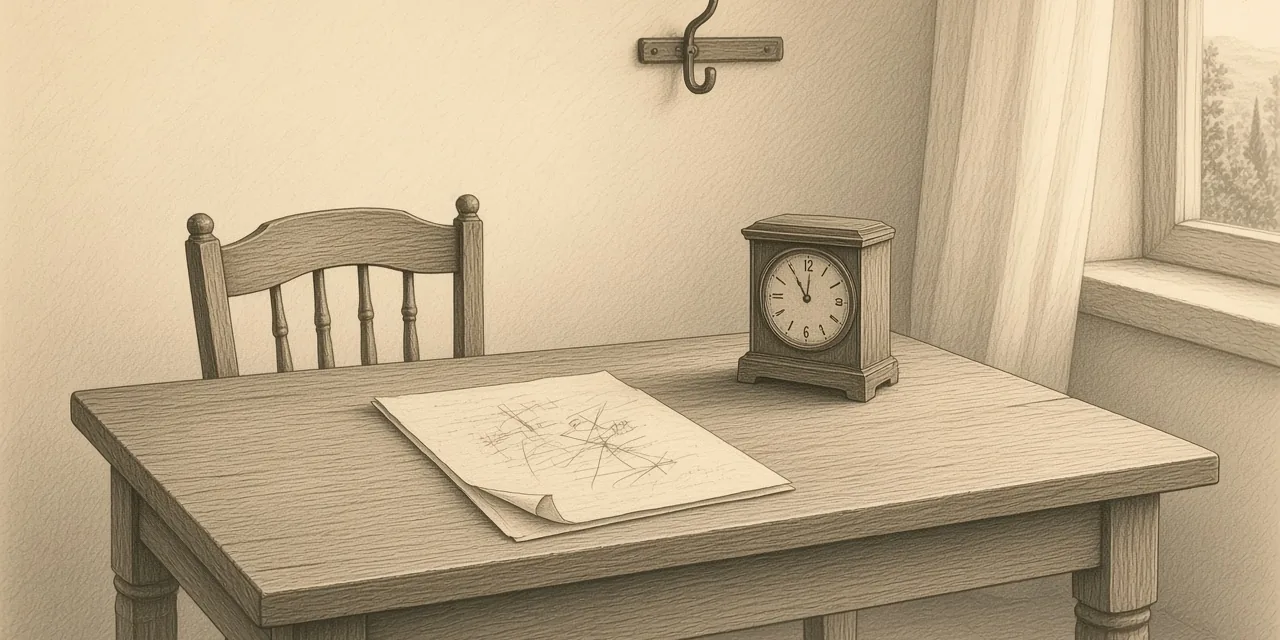
You turn the sheet. On the recto, in a clean hand that no one disputes, Federico García Lorca has copied «La raíz amarga» — the poem that would enter Diván del Tamarit as «Gacela de la raíz amarga» — dedicated it to the Uruguayan poet and consul Julio J. Casal, and signed «Madrid — 1933 —». On the verso, in pencil, with strike-throughs and second thoughts, other lines begin. The opening that can be read with reasonable confidence on the partial photographs published by the Spanish press is «Canta el reloj». A little lower: «Yo —». Near the bottom, a fragment: «que yo dejé».
What those lines say, in the form reported by EFE when it covered a calligraphic report in September 2026, is brief: «Canta el reloj / cuento maquinalmente las horas / da lo mismo las siete que las doce / yo no estoy aquí / es la señal de carne que dejé al irme / para saber mi sitio al regresar». Other outlets print different openings and lineation — «Canto» instead of «Canta», «cuenta» instead of «cuento», «Es lo mismo» instead of «da lo mismo» — and RTVE's Telediario aired a recital version that starts «Canto, / El reloj cuenta…». There is no settled critical text. We quote one named press lineation and leave the variants visible.
The sheet entered public view in April 2026, when the singer Miguel Poveda announced that he had bought the manuscript from a German dealer and, turning it over, found the pencil draft. The philologist Pepa Merlo identified the hand as Lorca's; together they published the short volume Las cosas del otro lado. Lo inédito en Federico García Lorca (Biblioteca de la casa del Darro / Elenvés), which includes the verso. We have not obtained the book. The auction and dealer chain that preceded the purchase — RR Auction among them — had already described pencil annotations «in another hand» on the reverse. That note is part of the document's public history, not a later polemic.
Within days, specialists who know Lorca's manuscripts disagreed. Andrew A. Anderson, Melissa Dinverno and Christopher Maurer, then preparing the Residencia de Estudiantes exhibition Lorca y el archivo: memoria en movimiento, said the verso hand was not his. Anderson later wrote to El Confidencial that the two faces are two hands, and that proximity to an authentic text does not authenticate what sits beside it. Andrés Soria Olmedo called the reverse apocryphal; José Antonio Llera summed up: a known Lorca autograph, and on the back a poem by an unknown author until proof is shown. On the other side of the split, Merlo held to content and graphic arguments; Álvaro Salvador defended the attribution in the press; and on 7 September 2026 two calligraphic experts at Tintaverum signed a report, excerpted by Poveda, concluding that «los textos manuscritos que aparecen en el documento cuestionado fueron escritos por Federico García Lorca». We have not seen the full report — only the conclusions as carried by EFE, ABC and eldiario.
The dispute did not close. On 3 October 2026 Anderson published a note in Granada Hoy: even after the book reproduced the full verso facsimile, his view and that of Dinverno, Maurer, Mario Hernández, Soria Olmedo and Christian De Paepe remained unchanged, and it matched what RR Auction had already flagged. On 1 November, the forensic graphistics researcher Manuel J. Moreno published, also in Granada Hoy, a comparative reading against Lorca's autograph of Juego y teoría del duende and related samples. His conclusion is asymmetrical and careful: the recto matches; the verso shows relevant dissonances in rhythm, spacing, jambas and letter forms, and does not, in his judgment, supply a sufficient graphistic basis for Lorca authorship. Merlo, interviewed the same day on COPE, still stood by the attribution after Tintaverum, and treated doubt as useful — while regretting that early scepticism had rested, in her view, on a partial television image.
So much for what can be documented from the public record. From here on, this is our reading. The Thresholds interest is not to award the verso to one camp. It is the strange fit between what the lines say and what the sheet has become. A clock counts the hours mechanically; seven and twelve are the same; the speaker is not here; what remains is a «señal de carne», a token of flesh left behind so that, on return, one might know one's place. On one face of the paper, Lorca is present by every ordinary test of hand and signature. On the other, presence is exactly what cannot be settled. The poem — whoever wrote it — stages absence where a signature usually stages identity. The sheet has carried both conditions for decades: a confirmed return of the poet's hand, and a placeholder that still waits for an owner.
We do not know when the verso was written. The 1933 date on the recto does not date the reverse. We have not handled the sheet, read Merlo's study in the book, or reconstructed Tintaverum's full comparative method. What remains available to any reader is smaller and harder: an authentic document, words on the other side, and interpretations that refuse to coincide. The lines say the return will need a token of flesh. The paper has been that token. Whether Federico left it is still open.
A Note on Sources
Verses quoted from the EFE lineation of 11 September 2026; manuscript facts and the attribution split from named press reports and from the partial verso images published by El Confidencial, which we inspected; book and full Tintaverum report not obtained.
What is new. The Spanish press has covered the find and the dispute since April 2026; Granada Hoy published a six-month chronology on 3 October and Moreno's graphistic note on 1 November. What we add is not a verdict on authorship, but the juxtaposition of two facts that the coverage usually keeps apart: the speaker of the verso says «yo no estoy aquí», and the sheet itself now holds a confirmed Lorca presence on one face and an unresolved one on the other. We found no essay that centres that fit; if one exists, we will gladly note it.
Facts and reading. Recto authenticity, the 1933 dedication, Poveda's purchase, Merlo's attribution, the auction note of «another hand», the Residencia dissent, the Tintaverum conclusions as excerpted, Anderson's October note and Moreno's November analysis are reported as documented in the named sources below. That the poem's grammar of absence mirrors the document's unresolved presence is our interpretation.
What we don't know. Exact full transcription from a continuous high-resolution verso photograph (we have only partial press images). Dating of the verso. The full Tintaverum comparative tables. Merlo's published study inside Las cosas del otro lado, which we have not read. Whether dictation or a copy by another hand could ever be proven — a possibility Llera left open only if demonstrated.
Editions and quotes. Spanish verses after EFE, 11 September 2026; variants noted from RTVE, El Confidencial and Ideal as reported. English glosses are ours.
Verso lines beginning «Canta el reloj» on the reverse of Lorca's 1933 clean copy of «La raíz amarga»
An authenticated Lorca manuscript carries, on its verso, pencil verses about a clock that counts without caring and a speaker who is not here. Philologists, calligraphers and a forensic graphistics reading disagree on whether the hand is his. The attribution remains open.