The Time Between a Death and a Birth
An archive of children reporting past lives, a distance between two dates, and a small pattern still to understand.
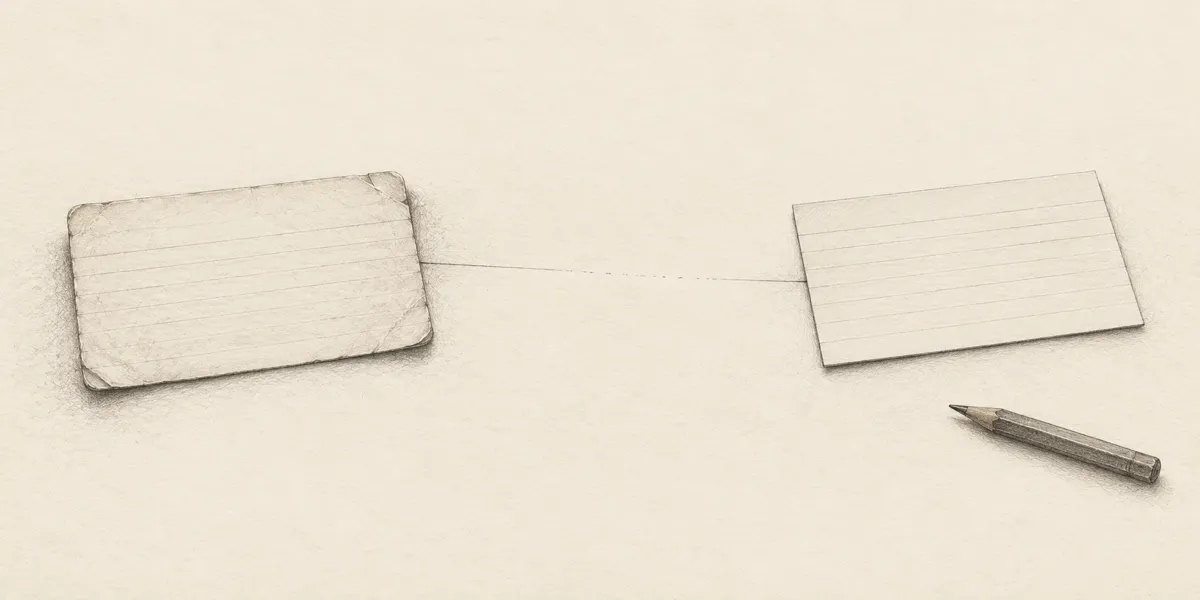
A date of death. A date of birth. Between them, a number of months.
It seems too spare an object to tell us anything about consciousness. Yet this subtraction is what three researchers at the University of Virginia chose to examine in an archive of children who report memories of a previous life.
One qualification belongs at the beginning. “Previous life” names the kind of case, not a conclusion we can take for granted. The deceased person is identified through the child’s statements and the investigation that follows. Expectations, mistakes and contact between families can enter that process. Once a person has been identified, however, the interval between death and birth is a measurement of two dates. It no longer depends on how vivid the story sounds.
Saeedeh Sadeghi, Marieta Pehlivanova and Philip J. Cozzolino examined the Division of Perceptual Studies archive: 2,254 cases collected over decades. A previous person had been identified in 1,678. Their 2026 paper in Psychology of Consciousness asks whether the interval is associated with how unexpected the death was.
They report a small association. Among cases with the necessary measurements, more unexpected deaths tend to be followed by shorter intervals. Median intervals range from about twenty-one months for deaths anticipated more than a month beforehand to twelve months for wholly unexpected deaths. This is a difference between distributions, not a timetable for any individual case.
Twenty-one to twelve is the striking comparison. The more sobering figure is the correlation: around −0.13. Unexpectedness alone therefore leaves almost all the variation in intervals unexplained. Both observations can hold: a noticeable difference between groups and modest predictive power.
Exact dates, uncertain files
The authors examined several proposed explanations involving how cases are assembled: verification quality, possible contamination of memories, prior acquaintance between families, social interest and belief in reincarnation. The results do not consistently follow the directions those explanations would predict. One example is a stronger association in families whose religions do not endorse reincarnation.
That does not eliminate ordinary explanations. Religious affiliation is not a direct measure of a family’s beliefs. Available variables cannot exhaust cultural differences. And although the comparison by verification quality points in the direction the authors consider favourable, the formal interaction is not statistically significant. Failing to find a predicted bias does not establish that other biases are absent.
This remains an observational archive, not a random sample of births, deaths or children. Someone had to report, investigate and code each case. Even an exact subtraction can inherit uncertainty from the process that put its two dates in the same file.
There is now a practical way to revisit those files in de-identified form. In September the authors deposited the data, variable definitions and R code on Zenodo. Researchers who disagree with the collecting institution’s interpretation can inspect the material too.
The space between the dates
The useful question is not yet who returns. It is closer to the workbench: why, in this archive, is the way a life ends associated with the time until a birth that will later be linked to that life?
The answer may involve case selection, identification, cultural composition or something the available variables do not describe. The data do not choose for us. The authors themselves do not present their findings as proof of reincarnation.
The space between the dates remains. We do not yet know what it tells us. At least it can now be reopened.
A Note on Sources
Observational analysis by Sadeghi, Pehlivanova and Cozzolino (2026), DOI 10.1037/cns0000493. The archive contains 2,254 cases; 1,678 have an identified previous person. The correlation of −0.13 concerns the subset of 1,075 cases with the necessary data, not the whole archive. Comparisons and checks are those reported in the study. This note does not claim a new independent replication of the analyses. Zenodo provides de-identified data and code. No causal or metaphysical inference is established.
A Large-Scale Analysis of Temporal Patterns in Children’s Purported Past-Life Memories
Saeedeh Sadeghi, Marieta Pehlivanova & Philip J. Cozzolino. Psychology of Consciousness: Theory, Research, and Practice (2026).