The Tunnel Is Gray
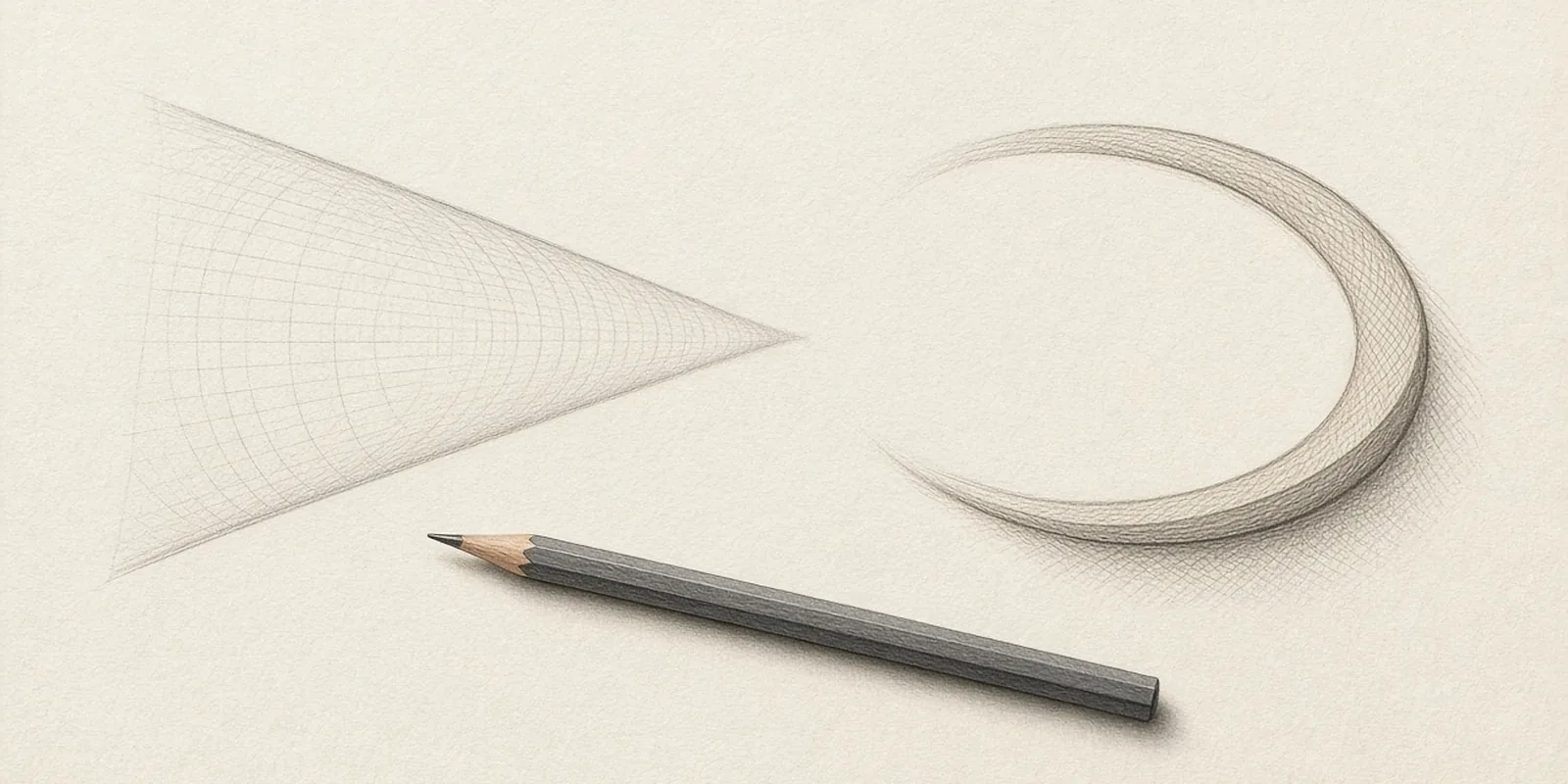
Fifty people who reported a near-death experience were asked to draw the spaces they remembered. Conical passages came out mostly without colour; open, arc-bounded spaces came out mostly chromatic.
Ask someone who has come back from a near-death experience what the place looked like, and the answer often stalls. Words fail; the report turns metaphoric. Ask them to draw it, and something more countable appears: a shape on a page, and sometimes a colour — or the refusal of colour.
In a study published on 15 October 2026 in Frontiers in Psychology, France Lerner, Paulo Cezar Rocha dos Santos and Guillaume Tahar asked fifty people who reported an NDE to sketch the spaces of that episode and then classify each sketch against a short list of spatial types. The question was not whether the experience was «real». It was whether the geometry people draw and the colour they assign tend to move together.
Two geometries, two palettes
Of 112 spaces collected across the fifty completers, two types dominated. Type A was a conical or corridor-like passage, often widening toward a light. Type B was an open space bounded by a soft elliptic arc. Type A sketches were achromatic in 22 of 28 cases. Type B sketches were chromatic in 27 of 31. The Fisher exact test on that contingency returned p = 3.71 × 10⁻⁶. A generalised estimating equations model that kept multiple spaces from the same person gave an odds ratio of about 18.4 for chromaticity in Type B relative to Type A. When the authors re-ran the model with a Mancl–DeRouen correction for the small number of clusters, Type B remained the clearest signal.
The figures are exact counts from the paper, not approximations. They do not say that every tunnel is gray, or that every open arc is coloured. They say that, in this sample, the two associations are strong enough that chance alone is an awkward explanation.
What the method can and cannot hold
Participants were recruited through IANDS networks. Reports were retrospective; the median lag from the reported episode to the questionnaire was 15.1 years. There is no contemporaneous recording of the event, no independent check that a given sketch matches what was lived, and no claim by the authors that the geometry is a window onto a physical place. The study is a structured look at how people who already frame an episode as an NDE organise its remembered spaces on paper.
Colour was scored as present or absent, not as a spectrum of hues. Spatial type was assigned from a closed list. Both choices make the contingency table possible; both leave out finer variation. Sample size is fifty completers — enough for the association reported, not enough to settle how the pattern travels across cultures, etiologies or decades.
Geometry as a way past the ineffable
The interesting move is not mystical. Near-death reports are often described as hard to put into language. Asking for a sketch and a spatial label does not unlock the experience; it asks whether the parts that can be externalised — a cone, an arc, the presence or refusal of colour — hang together across people. If they do, the ineffable has at least one edge that can be counted.
The authors do not propose a mechanism. They do not argue that a gray tunnel is a collapsing visual field, or that a coloured arc is a glimpse of another world. Those readings sit outside the data. What the data support is a co-variation: in this group, conical spaces tend to be drawn without colour, and open arc-bounded spaces tend to be drawn with it.
A question that survives the numbers
If the association holds in a larger, less self-selected sample, the next useful question is not «which realm was visited». It is why two ways of organising remembered space would pull colour with them — or push it away — so consistently. Until that is tested, the honest residue of the study is narrower, and still worth keeping: when people who report an NDE are asked to draw rather than only to narrate, the gray tunnel and the coloured open space are not random companions.
A Note on Sources
Primary source: Lerner F., Rocha dos Santos P.C., Tahar G., "The perceptual geometry and chromaticity of near-death experience spaces", Frontiers in Psychology, 15 October 2026, doi:10.3389/fpsyg.2026.1760389. Full HTML text and supplement (including Table_4 crosstab) were read during the 19 October 2026 scout; core counts (112 spaces; Type A 22/28 achromatic; Type B 27/31 chromatic; Fisher p = 3.71e-6; GEE OR ≈ 18.4 for B; Mancl–DeRouen leaving B clearest; median lag 15.1 years) were re-checked against the saved extract and scout card on 5 November 2026. Earlier bioRxiv preprint 10.1101/2025.10.17.682526 was not compared line by line. Authors do not claim a mechanism or an afterlife; that limit is kept here.
Spatial structures of NDE spaces
Lerner, Rocha dos Santos and Tahar: phenomenological geometry and chromaticity of spaces reported in near-death experiences, Frontiers in Psychology, 15 October 2026.