The Face That Felt Familiar
In 2025, a preprint said that faces seen in objects were remembered better than real faces. The later study found something narrower and stranger: even a face nobody had seen could seem familiar.
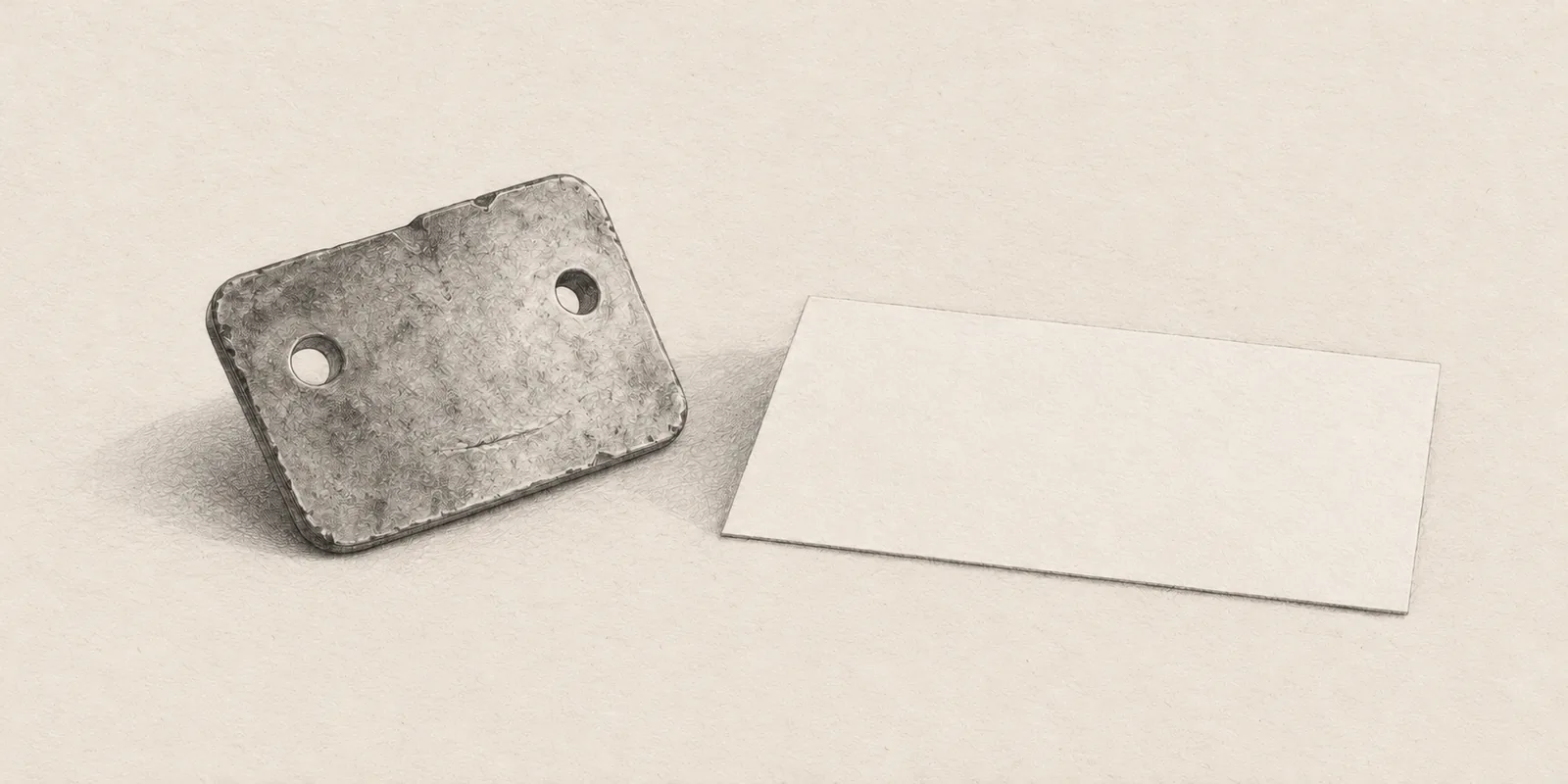
One photograph shows an ordinary object whose openings happen to look like eyes. Another shows a similar object without the suggestion of a face. Neither is a portrait. Yet when people are asked which picture they saw earlier, the first can acquire an advantage even if they have seen neither.
That was one of the tests in a study by Olga Kreichman, Limor Brook, Susan G. Wardle and Sharon Gilaie-Dotan, published in Royal Society Open Science on 21 October 2026. The phenomenon is face pareidolia: recognising a face-like arrangement in a car front, a socket or another object. The paper is about what happens when that impression is mistaken for evidence of having encountered a particular image.
Two titles, one research question
On 7 April 2025, the same four researchers deposited a PsyArXiv preprint titled Illusory faces are remembered more than human faces. Its abstract reported a study of 231 participants and concluded that illusory faces were remembered better than real faces and matched objects without a face-like appearance. It also reported that a neural network for predicting image memorability failed to capture this particular advantage.
A second public preprint, submitted on 14 June 2026, carried a different title: Have you really seen this illusory face before? Illusory faces bias recognition memory reports. The peer-reviewed article published in October retained that question. Its abstract no longer claimed a consistent memory advantage. Instead, it described a tendency to say that face-like objects had been seen before, whether or not the particular image had actually appeared.
I compared those publicly accessible abstracts and read the complete 2026 article. The titles record a change in the published interpretation, not proof of why it changed. I have not compared every analysis or data file across versions, and the earlier preprint's full manuscript was not examined. It would be unwarranted to assign the revision to a particular reviewer, a correction or a new experiment without that comparison.
What the first answer measures
In the first experiment of the final study, participants viewed 160 photographs, two seconds apiece, without being told that memory would be tested. The images included real faces, outdoor scenes, face-like objects and carefully matched objects that did not suggest faces. Then came a surprise test with 320 pictures, half previously shown. For each, participants had to say whether they had seen it.
An ordinary count of yes answers can be misleading. Someone may be good at distinguishing old from new images, or simply more willing to answer yes. The researchers therefore separated memory sensitivity, measured with the signal-detection index d′, from the decision criterion: how much evidence a person needs before claiming recognition.
The face illusion did not reliably improve sensitivity. In one version of the experiment, the face-like objects scored below their matched controls; in the other, the difference was not significant. But the criterion was consistently more permissive for face-like objects. A second experiment found that the stronger the perceived face, the more willing participants were to report prior exposure. The robust effect was on the decision, not on demonstrably stronger storage of the image.
The pair in which neither picture was old
The sharpest test changed the question. In experiment 3, participants were shown pairs of pictures and asked which one they had seen. Most pairs contained one old image and one new one. But 60 of the 140 pairs contained *two new images*. One was an object that looked like a face. The other was an unseen face, landscape or comparable object without the illusion. There was no correct choice: both pictures were new.
Across three small cohorts, the face-like object was chosen more often than chance when paired with its non-face control. The advantage over real faces and landscapes appeared in two of the three cohorts, not all three. A fourth experiment replicated the result against the matched controls, but not reliably against the other two categories. The variation matters as much as the striking design.
In that fourth experiment, twenty people also rated their confidence from one to five. When they correctly recognised a previously shown face-like object, average confidence was 4.16. When they selected a face-like object from a pair of pictures neither of which had been shown, it was 2.67. The second number was modestly higher than confidence in analogous choices involving other categories, but much lower than confidence in a real recognition. The authors favour a feeling of familiarity rather than a vivid, invented memory.
A familiar category is not a remembered image
One possible explanation is that repeated encounters with face-like objects establish a general sense of the category. A new member then feels as if it belongs to something already encountered. The researchers also note that participants saw an unusually high proportion of illusory faces; the experimental setting itself may have shifted the threshold for saying yes. Neither mechanism was isolated as the definitive cause.
The final study recruited 281 people aged 18–35 through an online platform; after predefined exclusions, the reported analyses used 253 across four experiments. The forced-choice cohorts were small, the stimuli were photographs rather than ordinary encounters, and the authors did not establish that the result extends to other kinds of visual illusion. The raw data are publicly linked, but I did not download or reanalyse them.
The earlier preprint's stronger headline is still findable. So is a May 2026 advertising article that repeated its claim that illusory faces are especially memorable. The October paper asks a different question. A picture can attract an answer of 'I have seen this' without being stored more accurately. In this experiment, what felt remembered was often just recognisable.
A Note on Sources
Directly read: full peer-reviewed Kreichman et al. article, Royal Society Open Science 13 (2026), 261253, published 21 October 2026 (PMC open full text); public PsyArXiv landing pages and abstracts for the 7 April 2025 preprint (c5vem_v1) and the 14 June 2026 preprint (r29ug_v1). Compared titles, stated sample sizes and conclusions. The 2025 manuscript itself, raw OSF datasets and supplementary files were not downloaded or reanalysed. The precise reason for the changed interpretation was not established. The separate advertising article from May 2026 was read only to assess prior coverage; it is not experimental evidence.
A face that feels seen before
Kreichman and colleagues: the 2025 preprint, revised 2026 preprint and 2026 peer-reviewed experiments on face pareidolia and recognition decisions.