The Bottle Moraine
Hundreds of bottles emerge from a Swiss glacier. Their positions trace the movement of ice without preserving a perfect chronology.
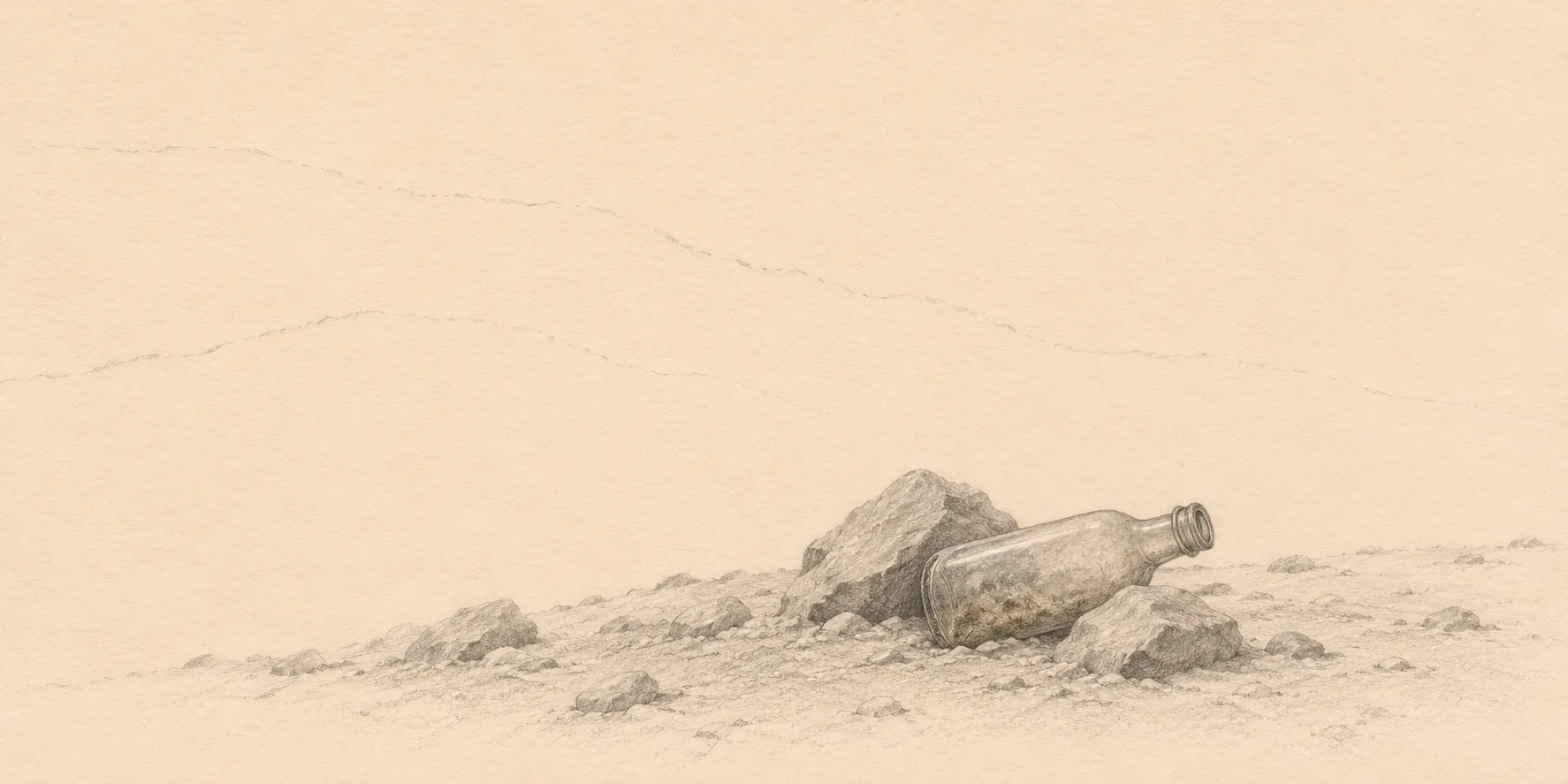
At Piz Murtèl in the Swiss Alps, a line of bottles lies among the stones of a moraine. It resembles the remains of a picnic, but the drinks were not necessarily consumed where their containers now rest. The glacier carried some of them there.
In September 2023, a routine glacier visit revealed an unusual concentration of glass and metal. A systematic survey on 9 October recorded 556 bottles, 42 cans and 24 locations with fragments, distributed among 150 recorded positions. Most were concentrated along roughly 200 metres of lateral moraine. The surveyors were not excavating a dump. They were mapping objects that had travelled with a changing landscape.
Elisa Götz, Matthias Huss and Lander Van Tricht described the site in a paper published in July 2026 in Arctic, Antarctic, and Alpine Research. Their question was physical as much as historical: where had the objects entered the ice, how might they have moved, and when did the glacier leave them behind?
Ten dates among hundreds of objects
Only ten objects could be assigned approximate production periods from labels, manufacturers and archival material. That is a thin chronology for almost six hundred recorded bottles and cans. Yet a pattern appeared: older items tended to lie farther downslope, younger ones higher along the moraine.
The individual objects resist a neat timeline. A mineral-water bottle and a clear glass bottle were found at the same location despite their different estimated ages. Production dates are ranges, not the dates when someone opened a drink or discarded a container. The researchers report uncertainties of ten to forty-five years in those production windows.
The summit provides a plausible starting point. Tourism in the area expanded over the twentieth century, including summer skiing. The authors infer that visitors left containers near Piz Murtèl's summit; the objects subsequently moved downslope in ice, across snow or over the glacier surface. This is a reconstruction supported by the distribution and a flow model, not an eyewitness record of who threw what.
Forty years for 260 metres
The team combined field positions, historical imagery and a three-dimensional ice-flow model. At a mean speed of about 6.5 metres a year, an object would need roughly forty years to cover 260 metres. That is a plausible journey for some of the older finds.
But the younger objects complicate the route. At modelled speeds of five to six metres per year, less than twenty years of movement would account for roughly 110 metres, about half the necessary distance for certain finds. The paper therefore considers sliding or tumbling on the surface in addition to transport inside the ice. Historical photographs also suggest that parts of the steep summit flank became ice-free in late summer, making a single continuous ice conveyor an inadequate picture.
The authors acknowledge uncertainties in bedrock geometry, modelled flow direction and the unknown moment of disposal. The model is more useful for identifying a likely origin and broad transport mechanisms than for tracing one particular bottle from hand to stone.
A margin drawn with rubbish
The most unexpected result is spatial. The approximately 200-metre line of objects marks a former glacier margin. In this area, the researchers found that the ice edge remained virtually unchanged from 1955 to 1985, then retreated by about 20 metres by 2000 and more rapidly afterward. A line of refuse can become a clue to the former shape of ice.
This is not a claim that litter is a better measuring instrument than glaciological observations. The researchers use maps, photographs and simulations alongside the objects. Nor does the pattern make the moraine a reliable calendar: two containers beside each other need not belong to the same year.
What survives is an unusual form of evidence. An object can retain clues to when it was manufactured while losing its original location. The glacier preserved the bottle and rearranged its context. Reading that context requires resisting the temptation to turn a suggestive line into an exact sequence of human actions.
A Note on Sources
Primary source: Götz, Huss and Van Tricht, Arctic, Antarctic, and Alpine Research (28 July 2026), full HTML text consulted 5 November 2026. Counts, ten dated objects, model velocities and discussion of limitations checked. ETH Zürich institutional record also consulted. Supplementary material and original photographs not fully examined; no simulation rerun or independent field survey. Summit origin and trajectories are the authors' inferences; the reading of the moraine as an unordered archive is editorial.
A line of bottles on a lateral moraine
556 bottles, 42 cans and an ice-flow reconstruction with acknowledged uncertainty.