The Hand That Answers Under Anaesthesia
A paralysed patient can sometimes follow a command with one spared hand, then wake with no explicit memory of having done it.
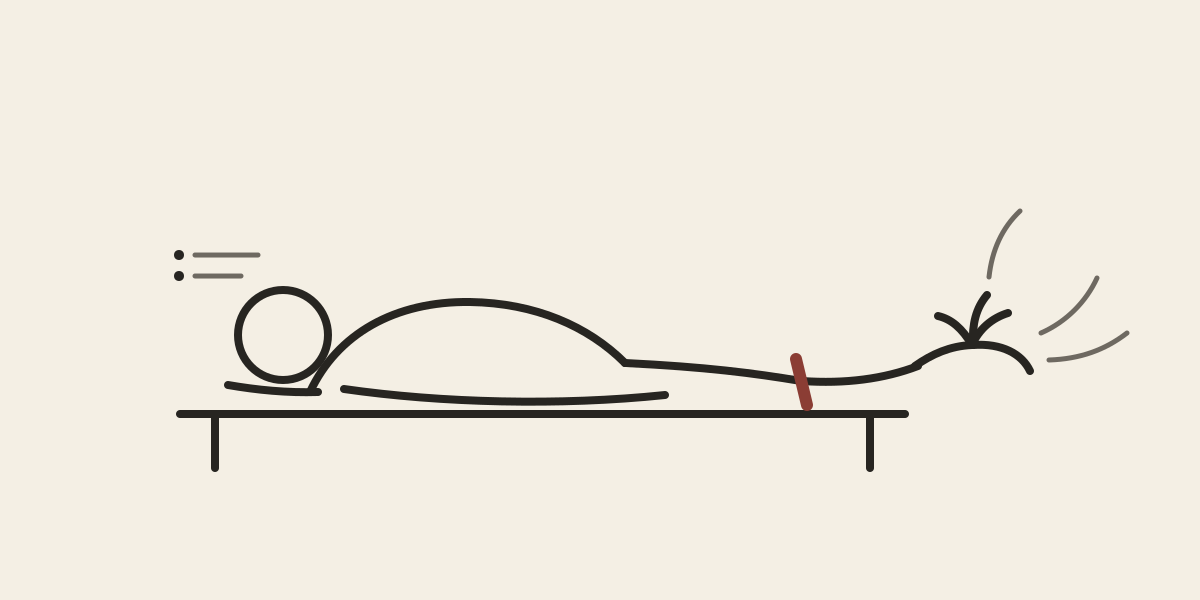
During general anaesthesia there is a surprisingly simple way to ask whether a patient is still reachable.
After induction, but before the muscle-blocking drug is given, a tourniquet is inflated around one arm. The neuromuscular blocker can paralyse the rest of the body without reaching that hand. A command can then be given: if you can hear me, squeeze.
The method is called the isolated forearm technique. M. E. Tunstall described it in 1977 during anaesthesia for caesarean section. It has since become one of the most direct experimental tools for looking for what researchers call connected consciousness: the capacity to receive something from the external world and respond intentionally while anaesthesia is meant to have broken that connection.
In 2017 Robert Sanders and colleagues used it at six centres in 260 adult patients, shortly after tracheal intubation. Twelve responded to command: 4.6%. Five of those twelve, questioned with a second squeeze code, reported pain. When 253 participants were questioned after surgery, none reported explicit recall of the intraoperative events.
That 4.6% does not mean that one patient in twenty remains conscious throughout an operation. The measurement concerns a particular window, just after intubation, and a particular behaviour: a motor response to command. In 2022, restricting the study to young adults aged 18–40, another international cohort found responses in 37 of 338 people, or 11%. Again, the test was performed shortly after intubation.
A response the monitor may not see
The harder result to place comes from the electroencephalogram. In a subgroup of 90 patients studied in 2017, six gave volitional responses. Three did so while their frontal EEG showed the familiar alpha–delta pattern seen during anaesthesia and associated with deep disconnection. Derived EEG depth indices did not reliably separate responders from non-responders.
That does not make anaesthesia monitors useless, and it does not show that the EEG is somehow “wrong”. It says something narrower: a particular electrical pattern, by itself, does not guarantee that a voluntary response to the outside world is impossible.
A subtler dispute remains. What, exactly, does a hand squeeze prove? Many anaesthesia researchers use it as an operational sign of connected consciousness. Jaideep Pandit has proposed that anaesthesia can also produce intermediate states — which he called dysanaesthesia — in which perception, experience and reaction do not line up in their ordinary way. Other authors caution against turning a motor response into a complete description of the patient’s mental state.
The technique therefore measures something strong, but not everything: the patient received a command and the nervous system produced the requested response. How rich the subjective experience accompanying that act may have been is a further question.
The experience that does not reach the future
This is where memory changes the problem. In the large 2017 cohort, none of the participants questioned afterwards explicitly remembered the events detected with the isolated hand. An older experiment by Ian Russell, performed in 1993 with an intravenous regimen that is not representative of routine modern practice, showed an even sharper dissociation: many patients responded during surgery, none recalled it spontaneously afterwards, and three produced evidence of recall only when specifically prompted.
So it would be a mistake to turn “I remember nothing” into “there was no experience”. It would be just as mistaken to infer from a squeezing hand that a fully alert and continuous consciousness was present.
Between those claims is a gap. At some moments a patient can be connected enough to the world to understand a request and answer it, while the self that wakes later retains no explicit access to that moment.
Anaesthesia has not given us proof of a hidden consciousness. It has given us a more precise question: how much of being present depends on being able to carry that experience with us a few minutes later?
A Note on Sources
The isolated forearm technique keeps one hand mobile by excluding the neuromuscular blocker, not the general anaesthetic. The 4.6% figure (12/260) comes from the 2017 multicentre study after intubation; five responders reported pain and none of the 253 patients assessed afterwards had explicit recall. The 11% figure (37/338) concerns young adults in the multicentre study published in 2022/2023. IFT responses are used as a measure of connected consciousness, but their phenomenological interpretation remains debated. Russell’s 1993 study used a low-dose regimen that was not recommended for general use and should not be read as an estimate of current routine anaesthesia.
Connected consciousness during general anaesthesia
From Tunstall’s 1977 protocol to contemporary multicentre studies of the isolated forearm technique, EEG, volitional response and postoperative memory.