Baseballs, Fake Errors, and the Practice of Noticing a Dream
One virtual room hid baseballs. Another pretended to lose its connection. Two lucid-dream experiments show how much depends on what is practised—and what counts as evidence.
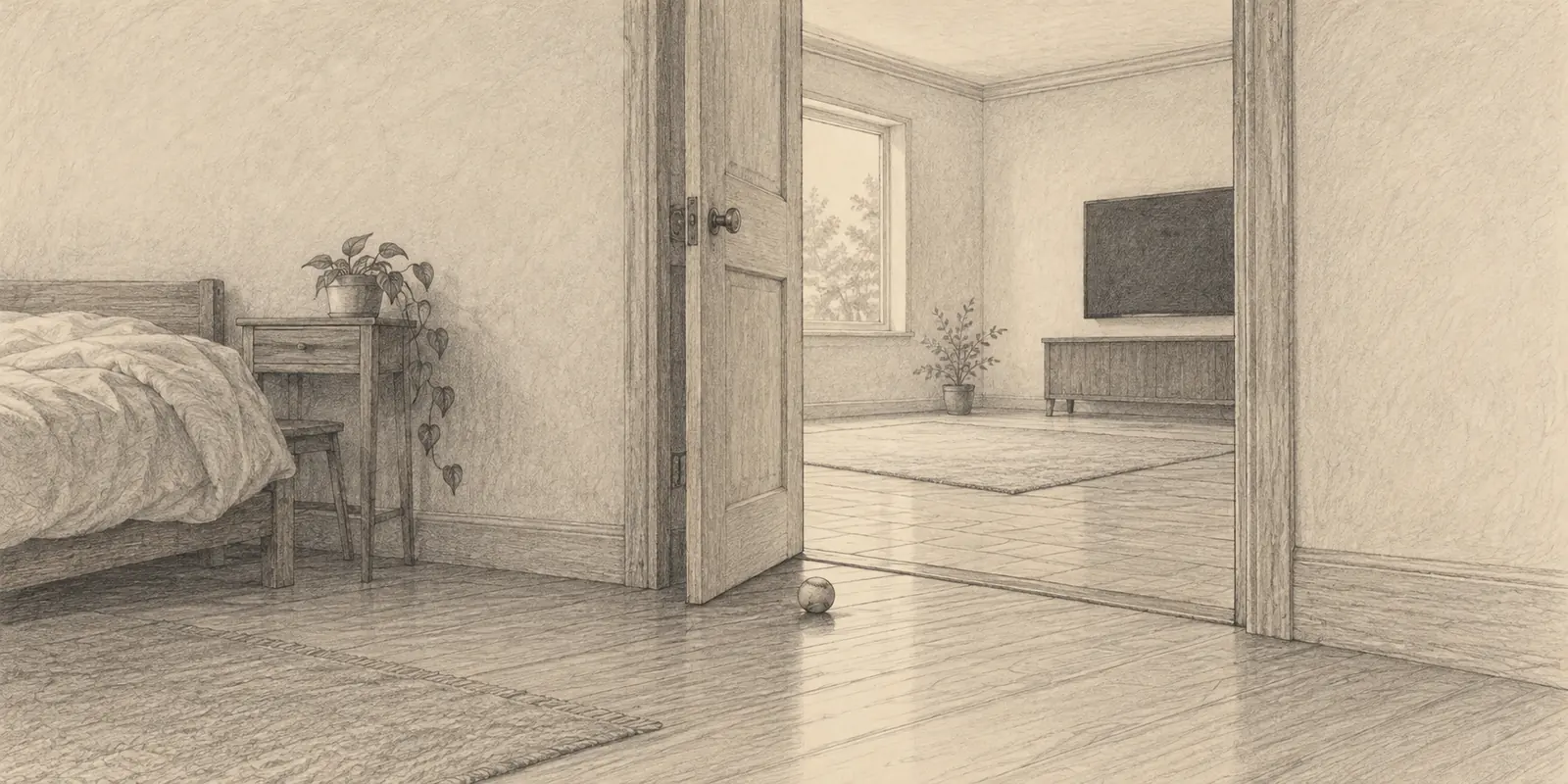
In a virtual room at the University of Trento, participants had to look for baseballs. Some were hidden among cushions, others in a landscape outdoors. It was a quiet search task, without instructions to question reality. In a second experiment, at the University of Bern, the virtual room was a copy of the sleep laboratory. Every so often the display went black. A fake device error appeared, followed by a countdown and a message that the connection had returned.
Both rooms belonged to experiments about lucid dreaming: becoming aware, while still asleep, that the experience is a dream. The baseballs were a control task. The errors were an attempt to provoke doubt. Reading the two studies together makes the question less simple than whether a headset can teach someone to wake up inside a dream.
The room with the baseballs
The Trento study, published in Frontiers in Psychology on 28 September 2026, followed 38 adults with little previous experience of lucid dreaming for five weeks. Everyone kept a dream diary and practised daytime reality checks: examining the hands, testing a light switch, or pinching the nose and trying to breathe. Twelve daily phone reminders, between morning and evening, encouraged the habit.
Thirteen participants also completed eight sessions in an application called LucidDreamingVR. Each session began with roughly fifteen minutes of open-monitoring meditation, then about twenty minutes of interactive scenes: noticing impossible details, checking whether the scene made sense, trying to remain lucid, eventually practising imagined actions such as flying. Twelve others spent their VR sessions searching for baseballs in largely similar environments. The remaining thirteen used the diary and reality checks without VR.
The diaries contained 873 recalled dreams. The authors counted 26 as lucid or semi-lucid in the dream-training VR group, eleven in the no-VR group and four in the baseball group. Relative to all dreams recalled in each group, the proportions were 11.82%, 2.96% and 1.37%. Their rate model found the dream-training condition higher than either comparison condition. The difference between the two control groups was not statistically significant.
The word semi-lucid carries considerable weight here. Participants could answer yes, no or maybe when asked whether they had had a lucid dream. The researchers grouped the maybes with the yeses. Of the 26 lucid-like dreams in the experimental VR group, nineteen were in the maybe category. The counts of unequivocal yes reports were seven, four and one, respectively. These were dream diaries, not episodes confirmed by recording the sleeper's eye movements.
In two of the seven yes reports from the experimental group, and one of the nineteen maybes, the dream description contained elements apparently borrowed from the VR training. The authors judged that such an element may have triggered lucidity in two cases. Those descriptions are suggestive; they cannot by themselves establish which part of the programme caused the result. The meditation, repeated practice and dream-oriented content were delivered together.
The room that pretended to disconnect
A March 2026 preprint by Emma Peters and colleagues at Bern used a different route. Across three studies, 101 people came to a sleep laboratory for morning naps. Some first spent ten minutes exploring a virtual copy of that same lab, collecting letters and checking their fingers. One variation added vibration to the wrist during REM sleep. Another inserted brief simulated system failures into the virtual scene: 'Device disconnected', then 'Reconnecting'. A comparison group received the lucid-dream instructions and pre-sleep audio without VR.
This time the investigators also looked for a signal from within sleep. Participants were told they could make a deliberate left-right-left-right eye movement if they realised they were dreaming. Electro-oculography during REM sleep could register that pattern, and two raters reviewed the traces. It provides an independent physiological marker alongside the dream report, although it too depends on participants following the protocol.
Across the studies, the team collected 121 dream reports. Twenty-eight described a false awakening: the person dreamed of waking up. In seventeen reports, lucidity emerged after such an awakening within the laboratory setting. The researchers also counted 58 reports containing the laboratory itself, its equipment or staff. The place where people expected to wake had become part of the dream.
In the primary comparisons, neither virtual rehearsal nor the simulated failures nor the wrist stimulation produced a statistically significant advantage over the lab-focused training without VR. Among the condensed dream reports used for the primary analysis, the signal-verified percentages varied between conditions, from 11.1% in the active comparison group to 32.1% in the VR-only condition, but the study did not establish a reliable difference. The authors caution that the comparison group underwent repeated REM awakenings, whereas the VR groups generally gave one report after the nap. The paper is a preprint, not yet peer reviewed.
What the two rooms cannot settle
These are not conflicting replications of the same experiment. Trento used weeks of training, included a preparatory meditation and measured participants' own classifications, including uncertainty. Bern used a short rehearsal immediately before a laboratory nap, external ratings of dream reports and eye signals. Its participants also varied in previous lucid-dream experience. Comparing the headline percentages as though they measured one effect would erase the experimental design.
There is, however, a useful shared detail. Neither experiment needed a spectacular dream world. The Trento control room hid ordinary sports objects. Bern tried to make an ordinary technical fault feel questionable. In Bern, the false awakening—the familiar act of getting out of bed, except that it had not happened—appeared repeatedly in reports where people became aware of dreaming. This association does not show that false awakenings caused lucidity, and the fake error messages did not demonstrably increase it.
The two studies leave an exact, practical uncertainty. Rehearsing a question about reality may help some people remember to ask it while dreaming. How much comes from VR, how much from the repeated question, and how much from the situation of sleeping in a laboratory is still unresolved. In Bern's simulated room, the device always reconnected. The study could not show that seeing that message helped anyone recognise the next room as a dream.
A Note on Sources
Directly read on 25 October 2026: Signorelli et al., Frontiers in Psychology (28 September 2026), methods, Table 2, results and limitations; Peters et al., bioRxiv preprint posted 12 March 2026, methods and results including dream-report and eye-signal verification. Counts and p-values are reported by the authors, not independently recalculated from raw participant data. The Frontiers dataset was not obtained; its availability statement offers data from the authors. The Bern work is a preprint and the conditions differed in awakening procedures. Neither study was reproduced and no VR application was tested for this article. The juxtaposition of the two protocols is this article's editorial reading, not a head-to-head study.
Two rooms built for lucid-dream research
Trento's five-week VR training and Bern's single-nap lab simulation, with different controls and different definitions of success.